


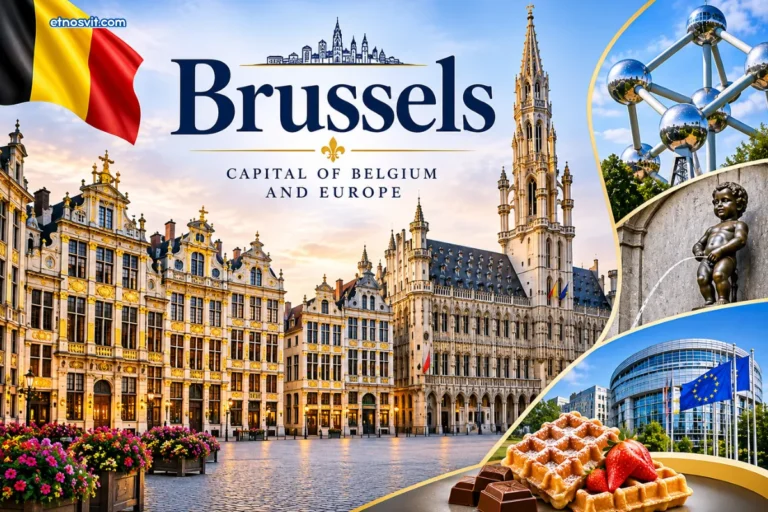
Brussels is an incredible city where medieval architecture meets modern Europe, and the aroma of chocolate and Belgian waffles fills its charming streets. The magnificent Grand-Place, the futuristic Atomium, the famous Manneken Pis, royal palaces and picturesque galleries create a unique atmosphere. Discover what to see in Brussels in one day, which attractions to visit, what to taste and when it is best to travel to the Belgian capital. Discover the heart of Europe with EtnoSvit!
Brussels – the City of Royal Palaces, Chocolate and European Contrasts
Brussels is one of the most distinctive cities in Western Europe, where medieval architecture stands harmoniously alongside modern districts, royal palaces alongside cosy cafés, and traditional chocolate shops alongside the offices of international organisations. The Belgian capital impresses visitors with its cultural diversity, rich history, gastronomic traditions and distinctive atmosphere of European openness.
Here you can admire the architectural masterpieces of the Grand-Place, ascend inside the futuristic Atomium, see the famous Manneken Pis, stroll through royal gardens and sample authentic Belgian chocolate.
Brussels is ideal both for an independent trip lasting several days and for a short excursion during a coach tour through Europe. Even a few hours in this city can provide numerous memorable experiences.
Brussels – the Capital of Belgium
Where Is Brussels Located?
Brussels is located in the central part of Belgium, between the historical regions of Flanders and Wallonia. The city is the country’s capital and the central part of the Brussels-Capital Region.
Thanks to its favourable geographical location, Brussels has become an important transport, cultural and political centre of Western Europe. It is a convenient starting point for travelling to France, the Netherlands, Luxembourg and Germany.
The official languages of the Brussels-Capital Region are French and Dutch. English is also widely used in tourist establishments.
The History of Brussels: From a Medieval Settlement to the Capital of Europe
The history of Brussels dates back to the Early Middle Ages. Thanks to its location along trade routes, the city gradually developed into an important centre of crafts, commerce and political life in historical Brabant.
Over the centuries, Brussels was ruled by various European dynasties that left a significant mark on its architecture and culture. Following Belgium’s declaration of independence in 1830, the city became the capital of the new state.
In the second half of the 20th century, Brussels gained particular international significance. Important institutions of the European Union and NATO headquarters were established here. This is why the city is often unofficially referred to as the capital of Europe.
Modern Brussels preserves its historical heritage while remaining a dynamic multicultural metropolis.
What to See in Brussels: Top 12 Tourist Attractions
Most of Brussels’ historical landmarks are concentrated in the central part of the city. However, to gain a comprehensive understanding of the Belgian capital, it is also worth visiting its modern districts and museum complexes.
1. Grand-Place
The Grand-Place (Grand-Place) is Brussels’ main historical square and a true treasure trove of European architecture. It is surrounded by richly decorated guildhalls, the magnificent Gothic Town Hall and the King’s House.
For centuries, the medieval square was a centre of commerce and public life. Following extensive destruction at the end of the 17th century, its architectural ensemble was rebuilt, creating a unique combination of historical styles.
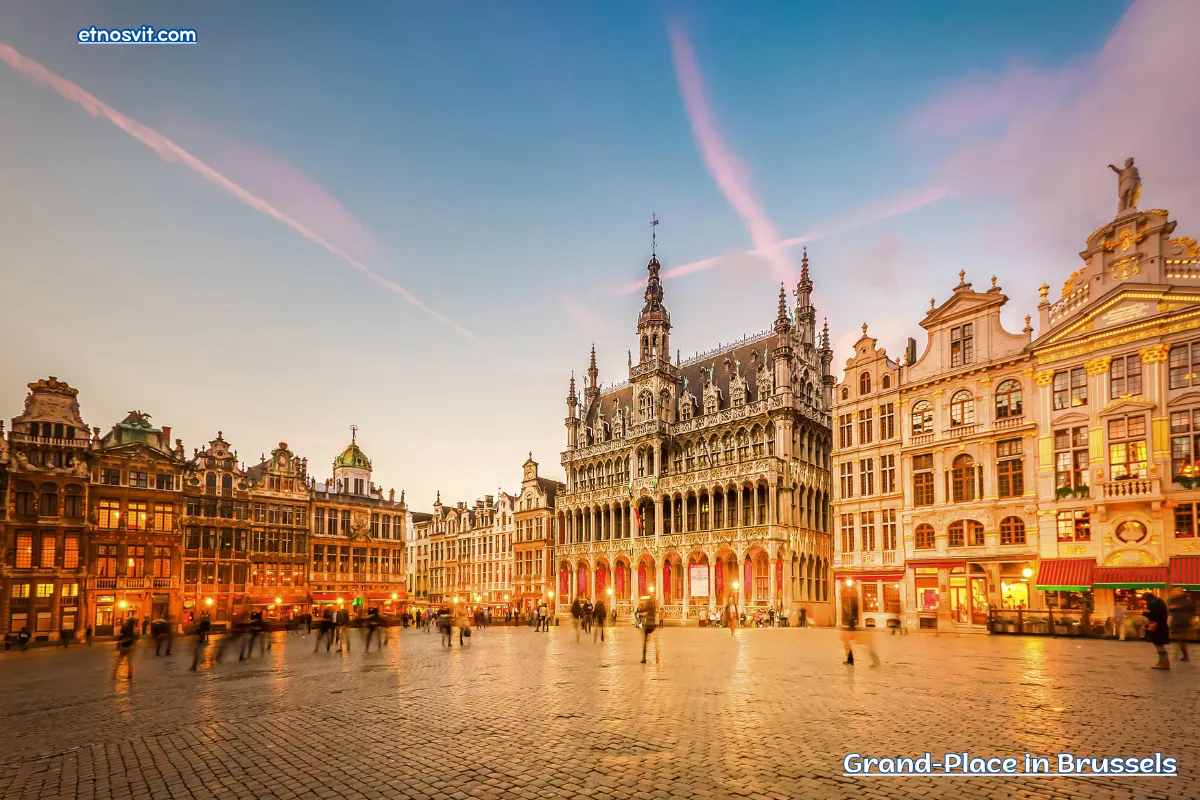
In 1998, the Grand-Place was inscribed on the UNESCO World Heritage List. The square looks particularly spectacular in the evening, when decorative lighting highlights its gilded façades and exquisite architectural details.
2. Brussels Town Hall
Brussels Town Hall is one of the most outstanding examples of civic Gothic architecture in Belgium. The 15th-century building dominates the Grand-Place with its tall, intricately designed tower, crowned by a statue of the Archangel Michael.
The façade is adorned with numerous sculptures, decorative elements and pointed-arch windows. The Town Hall remains an important administrative building, and its historic interiors can be seen during organised visits.
3. Manneken Pis – an Unusual Symbol of Brussels
Manneken Pis (Manneken Pis), known as the “Little Peeing Boy”, is a small bronze fountain sculpture that has become one of the city’s most recognisable symbols.
Numerous urban legends are associated with this landmark. Particularly interesting is the tradition of dressing the sculpture in various costumes during festivals, cultural events and ceremonies.
Despite its modest size, the fountain attracts the attention of tourists every day. It is located near the Grand-Place, making it easy to include a visit in a walking tour of the historic centre.
4. Atomium – Belgium’s Futuristic Landmark
The Atomium (Atomium) is a unique architectural structure standing 102 metres tall, created for the 1958 World’s Fair. Its nine metal spheres symbolise the structure of an iron crystal lattice magnified 165 billion times.
The structure became a symbol of scientific progress and technological achievements of the 20th century. Exhibition spaces are housed within the spheres accessible to visitors, while the passageways connecting them create unusual spatial experiences.
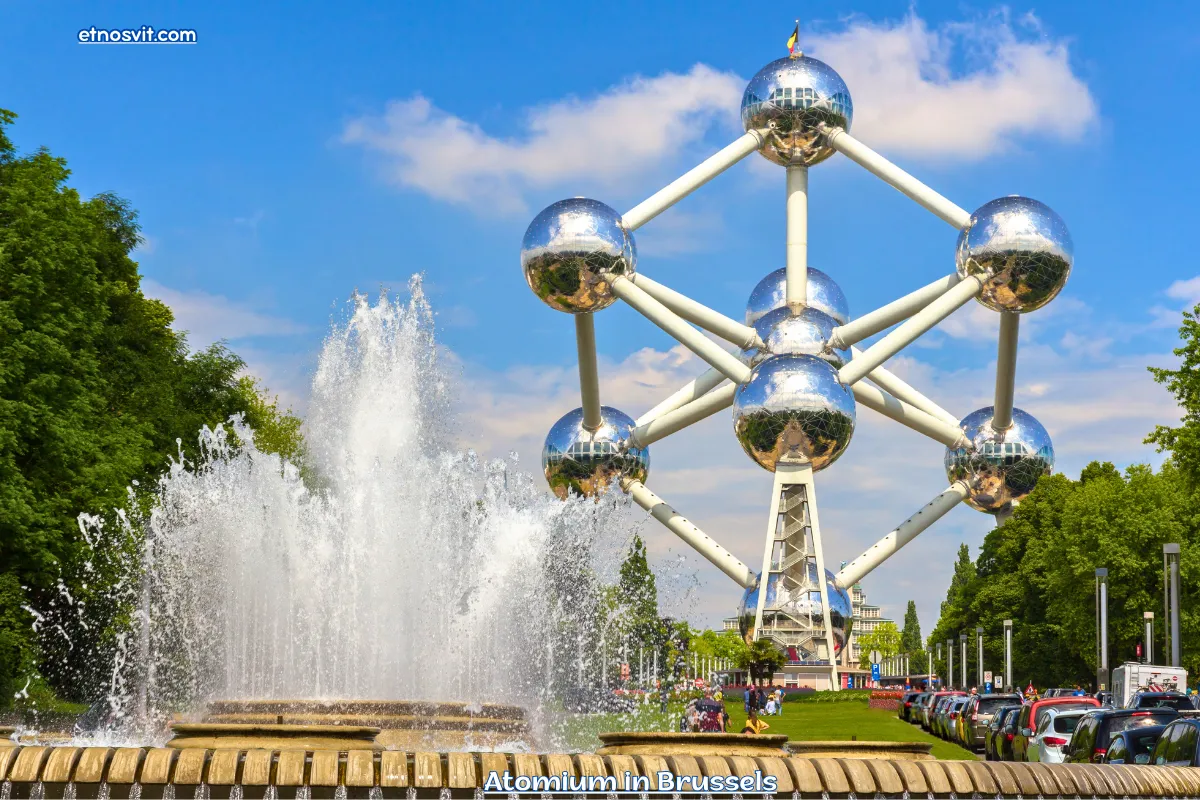
Atomium (Atomium) – the futuristic landmark of Brussels
The upper part of the Atomium offers panoramic views of Brussels. The attraction is located outside the historic centre, so additional time should be allocated for visiting it.
5. Mini-Europe Park
Mini-Europe Park (Mini-Europe) is located near the Atomium. It is a themed complex featuring miniature replicas of famous European architectural landmarks on a scale of 1:25.
During your visit, you can see models of famous palaces, cathedrals, bridges and other symbols of European countries. Interactive elements make the visit interesting for both adults and children.
Mini-Europe allows visitors to embark on a unique journey across the continent in just a few hours. A visit to the park can conveniently be combined with an excursion to the Atomium.
6. Royal Saint-Hubert Galleries
The Royal Saint-Hubert Galleries are an elegant shopping arcade opened in 1847. Its glass roof, exquisite façades and elegant shop windows recreate the atmosphere of aristocratic 19th-century Brussels.
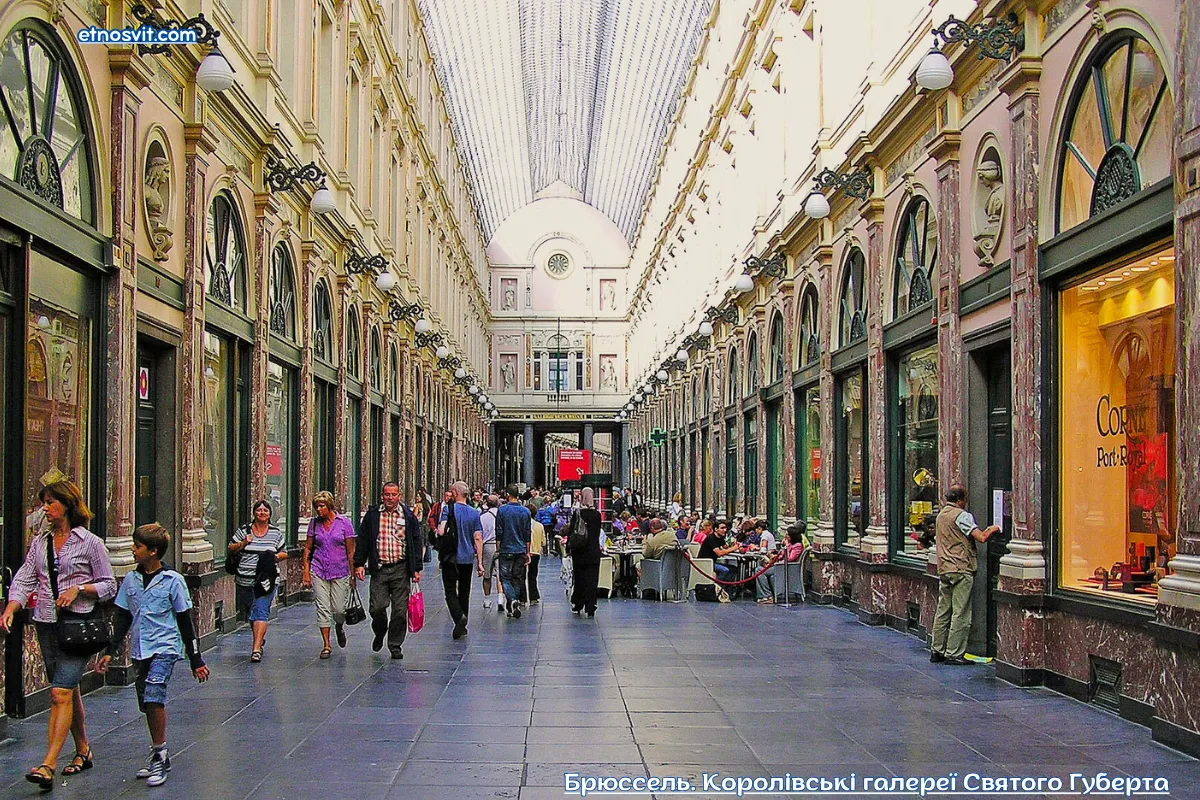
Royal Saint-Hubert Galleries – an elegant shopping arcade in Brussels, opened in 1847
Chocolate boutiques, shops, cafés and cultural establishments operate beneath the roof of this historic complex. It is an excellent place to purchase Belgian sweets, look for souvenirs or enjoy a leisurely stroll even in rainy weather.
7. Mont des Arts
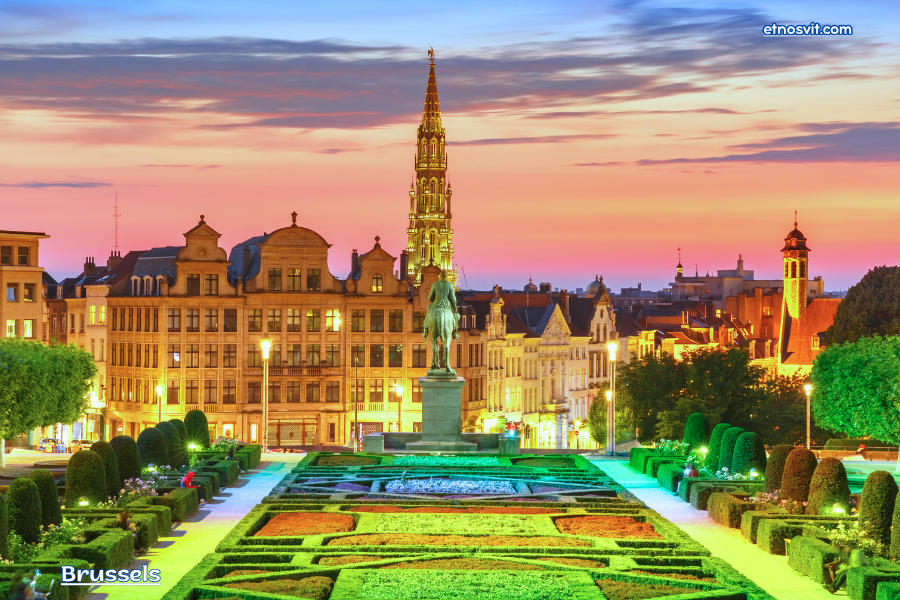
Mont des Arts (Hill of the Arts) is a cultural and architectural ensemble situated between the upper and lower parts of Brussels. Its main attraction is a geometrically designed garden surrounded by museums and cultural institutions.
The upper terrace offers one of the most famous views of the historic centre, with the Town Hall tower on the horizon. It is a popular photography location, particularly at sunset.
8. Royal Palace of Brussels
The Royal Palace is the official venue where the Belgian monarch performs some of their state duties. The magnificent building with its monumental façade is an important symbol of Belgium’s constitutional monarchy.
Opposite the palace lies Brussels Park, with its wide avenues, sculptures and green recreational areas. Exploring the Royal Quarter allows visitors to discover a more ceremonial and aristocratic side of the city.
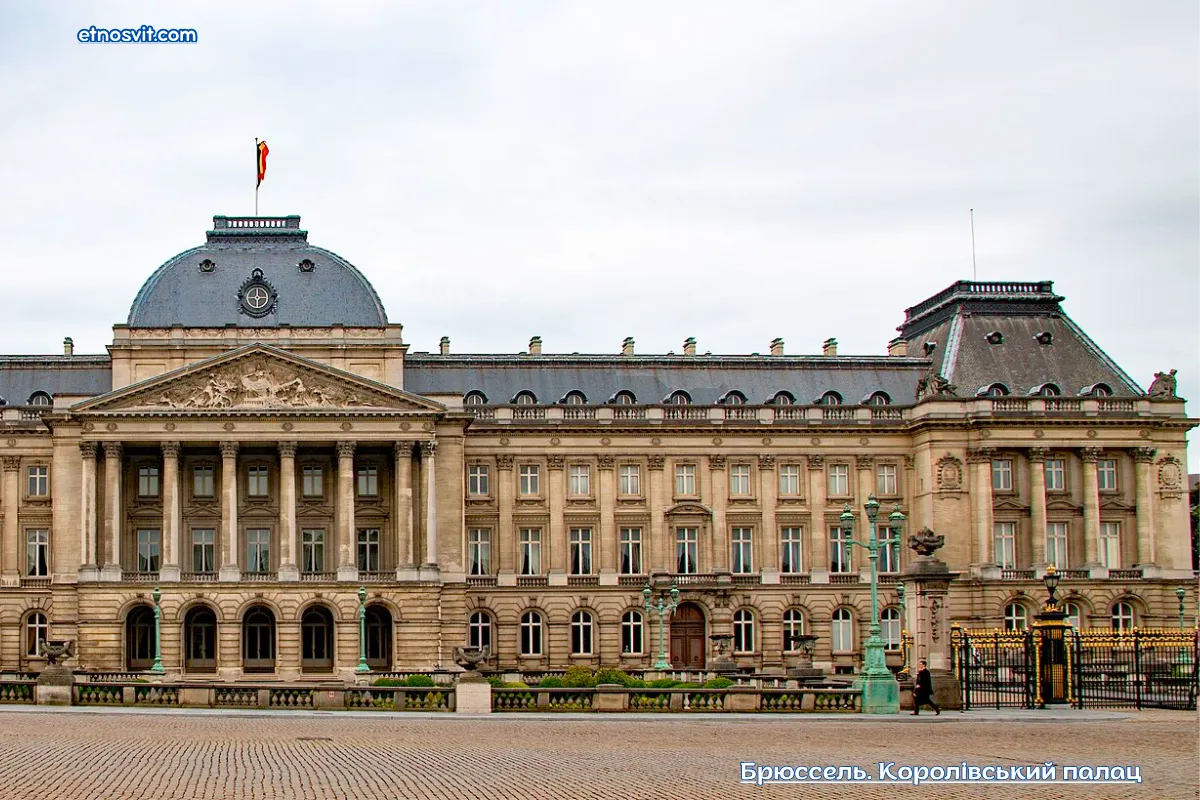
Royal Palace of Brussels, viewed from Place des Palais/Paleizenplein
The possibility of visiting the palace interiors should be checked in advance.
9. Cathedral of St Michael and St Gudula
The Cathedral of St Michael and St Gudula is one of the most outstanding religious buildings in the Belgian capital. Its Gothic towers, high vaulted ceilings and colourful stained-glass windows form a magnificent architectural ensemble.
The cathedral plays an important role in Belgium’s state and religious life. Ceremonial events associated with the royal family take place here. The cathedral is well worth visiting for enthusiasts of history and medieval art.
10. European Quarter and the European Parliament
The European Quarter demonstrates the modern character of Brussels. Numerous European Union institutions, international representative offices and administrative complexes are concentrated here.
Of particular interest to tourists is the Parlamentarium – an interactive museum dedicated to the history of European integration and the activities of the European Parliament.
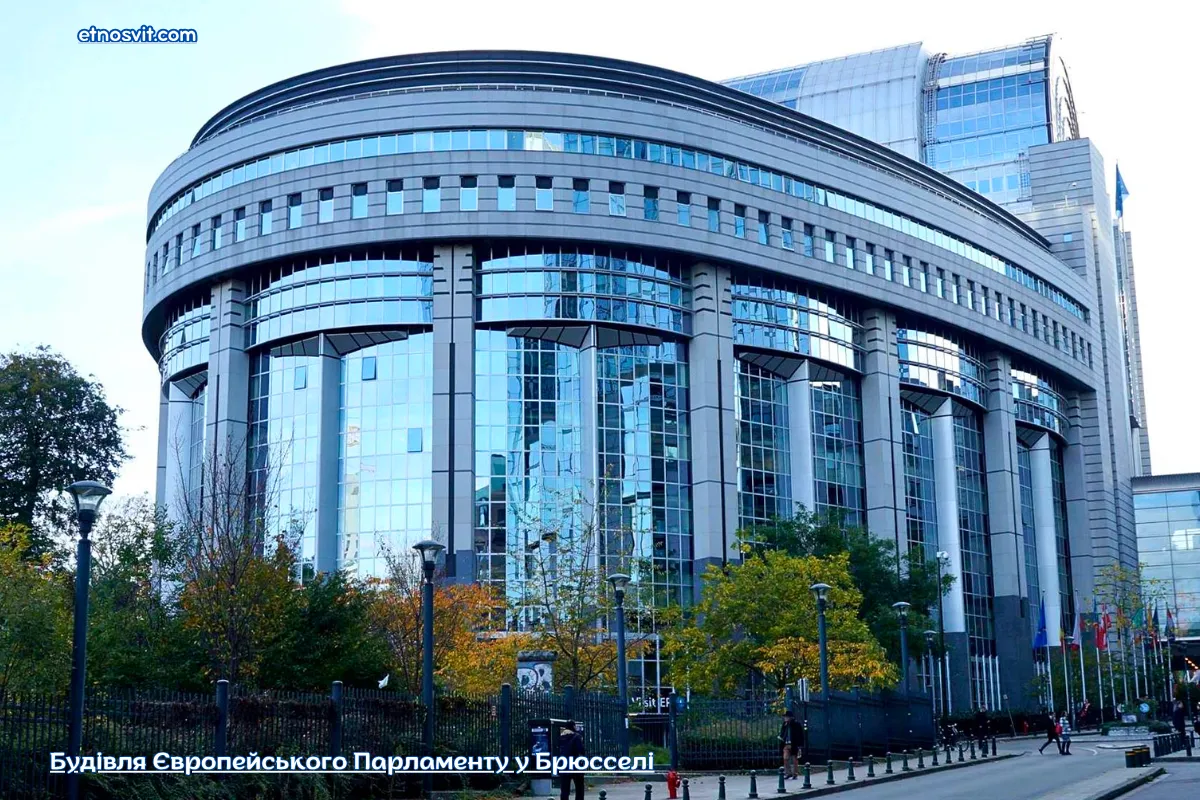
European Parliament Building in Brussels
A walk through the quarter can be complemented by visits to parks, modern architectural complexes and the House of European History.
11. Cinquantenaire Park
Cinquantenaire Park (Cinquantenaire) was created to commemorate the 50th anniversary of Belgian independence. Its most famous architectural feature is the monumental triumphal arch.
The complex houses museums dedicated to history, art, military heritage and automotive technology. Spacious green lawns make the park a pleasant place to relax between sightseeing excursions.
12. René Magritte Museum
Brussels is closely associated with the work of the Belgian surrealist artist René Magritte. The museum dedicated to him introduces visitors to his paintings, graphic art and creative explorations.
The exhibition allows visitors to immerse themselves in a world of unusual images, visual paradoxes and philosophical mysteries. A visit to the museum is an excellent addition to exploring the cultural heritage of the Belgian capital.
What to See in Brussels in One Day
If Brussels is part of a sightseeing coach tour, it is best to begin exploring the city in its historic centre. Most of its attractions are located within a short distance of one another.
Recommended walking tour itinerary in Brussels:
- Grand-Place and the Town Hall.
- Manneken Pis fountain.
- A walk along historic shopping streets.
- Royal Saint-Hubert Galleries.
- Cathedral of St Michael and St Gudula.
- Mont des Arts and its panoramic terrace.
- Place Royale and the Royal Palace.
- A walk through Brussels Park.
- Free time for lunch, chocolate shops and souvenirs.
Approximately 3–4 hours should be allocated for a leisurely exploration of the central part of the city. If you have a full day available, the second half can be devoted to the Atomium and Mini-Europe Park, using public transport.
If your time in the city is limited, it is better to concentrate on the historic centre rather than attempt to visit all the capital’s attractions.
Gastronomic Brussels: What You Must Try
The Belgian capital is a true discovery for enthusiasts of gastronomic tourism. Numerous confectionery shops, chocolate shops, restaurants and small street food establishments offer dishes that have long become cultural symbols of the country.
- Belgian chocolate. Pralines, truffles, chocolate confectionery and signature desserts created by local chocolatiers.
- Brussels waffles. Light rectangular waffles with a crispy exterior, served with icing sugar or various toppings.
- Liège waffles. Denser and sweeter waffles with caramelised pieces of sugar.
- Belgian fries. A popular street food traditionally served with various sauces.
- Mussels with fries. A classic combination in Belgian cuisine.
- Belgian beer. An important element of local gastronomic culture, with centuries-old brewing traditions.
A gastronomic walk is best combined with a visit to the historic centre, the Royal Galleries and small family-run shops.
Brussels – the European Capital of Comics
The art of comics is a distinctive cultural feature of Brussels. Belgium has given the world many famous authors and characters, including Tintin, the Smurfs, Lucky Luke and other heroes.
Large themed murals can be seen on building façades in various districts of the city. They form a unique open-air museum and allow visitors to discover Brussels beyond traditional sightseeing routes.
Enthusiasts of this art form should also consider visiting the Belgian Comic Strip Center, which explores the development of the genre and the work of its most famous representatives.
Brussels at Christmas
In the run-up to Christmas, the Belgian capital acquires a special charm. Historic façades are decorated with festive illuminations, market stalls appear in the squares, and the streets fill with the aromas of chocolate, waffles and spices.
One of the main winter events is the Winter Wonders festival, which brings together Christmas markets, light installations, gastronomic venues and festive entertainment.
The Grand-Place becomes particularly atmospheric. Visiting the city during this period combines perfectly with Christmas trips to Paris, Amsterdam, Bruges and other cities in Western Europe.
What to Visit Near Brussels
Thanks to Belgium’s compact size, the capital is an excellent starting point for exploring other tourist destinations in the country.
- Bruges. A romantic medieval city with canals, historic bridges, Gothic architecture and cobbled streets.
- Ghent. A historic city with magnificent cathedrals, picturesque waterfronts and the medieval Castle of the Counts of Flanders.
- Antwerp. An important cultural and commercial centre, renowned for its architecture, diamond industry and the heritage of the artist Peter Paul Rubens.
- Leuven. A historic university city with a magnificent Gothic Town Hall and atmospheric historic districts.
- Waterloo. A historic location associated with the battle of 1815, which brought the era of the Napoleonic Wars to an end.
Combining a visit to Brussels with visits to Flemish cities allows travellers to gain a much more comprehensive understanding of Belgium’s history, culture and architectural heritage.
When Is the Best Time to Visit Brussels?
Brussels is interesting throughout the year. The choice of season depends on the type of trip and personal travel preferences.
- Spring – a comfortable period for sightseeing, walks through parks and exploring architecture.
- Summer – the season of festivals, cultural events, outdoor terraces and long walks.
- Autumn – a good time for museum visits, gastronomic discoveries and photographing urban landscapes.
- Winter – the period of Christmas markets, festive illuminations and romantic journeys.
The changeable nature of Belgian weather should be taken into account. Even during the warmer months, it is advisable to carry a lightweight waterproof jacket or an umbrella.
Useful Tips for Tourists in Brussels
- Begin exploring the city at the Grand-Place.
- Choose comfortable footwear for walking around the historic centre, as some streets are cobbled.
- Use the metro or other forms of public transport to visit the Atomium.
- The official currency of Belgium is the euro.
- Check the opening hours of museums and tourist attractions before visiting.
- Whenever possible, purchase tickets for popular paid attractions in advance.
- Keep a close eye on your personal belongings in crowded tourist areas and on public transport.
- Do not limit your gastronomic exploration of the city to the main square: interesting establishments can also be found on neighbouring streets.
- During a short sightseeing excursion, leave time for an independent walk and souvenir shopping.
What to Bring Back from Brussels
The Belgian capital offers numerous original souvenirs associated with local history, gastronomy and cultural traditions.
- Belgian chocolates and pralines;
- traditional waffles and confectionery;
- Belgian lace;
- collectable comics and themed souvenirs;
- miniature models of the Atomium;
- items featuring symbols of the Grand-Place and Manneken Pis;
- souvenir mugs and products from local breweries.
Belgian chocolate remains a particularly popular gift, available both in famous confectionery shops and in small artisan workshops.
Tours to Brussels – Discover the Heart of Belgium
Brussels is a city capable of surprising even experienced travellers. Its medieval squares, futuristic architecture, royal residences, art museums and gastronomic traditions create a multifaceted image of a modern European capital.
A visit to Brussels combines perfectly with trips to Paris, Amsterdam, Bruges and other tourist cities. An organised coach tour allows travellers to discover several countries in a single journey while enjoying sightseeing excursions and new discoveries.
Discover Europe with the EtnoSvit travel company! Choose tours to Belgium and fascinating sightseeing itineraries, explore Belgium’s cultural heritage and embark on a journey filled with unforgettable experiences.
Brussels: Frequently Asked Questions from Tourists
What Is Brussels Famous For?
Brussels is famous for the historic Grand-Place, the Atomium, the Manneken Pis fountain, royal palaces, Belgian chocolate, waffles and the presence of important European Union institutions.
What Are the Must-See Attractions in Brussels?
The city's main attractions include the Grand-Place, the Town Hall, Manneken Pis, the Atomium, Mini-Europe Park, the Royal Saint-Hubert Galleries and Mont des Arts.
Can You Explore Brussels in One Day?
Yes, one day is sufficient to discover the main attractions of the historic centre. With proper itinerary planning, it is also possible to visit the Atomium.
Why Is Brussels Called the Capital of Europe?
The city acquired this unofficial title because it is home to important European Union institutions, including the European Commission and some of the European Parliament's structures.
What Does the Atomium Symbolise?
The Atomium represents the structure of an iron crystal lattice magnified 165 billion times. The structure was created for the 1958 World's Fair.
What Language Is Spoken in Brussels?
The official languages of the Brussels-Capital Region are French and Dutch. English is also widely used in tourist establishments.
What Food Must You Try in Brussels?
During your trip, it is worth trying Belgian chocolate, Brussels and Liège waffles, fries, mussels and traditional dishes of the local cuisine.
When Is the Best Time to Visit Brussels?
The period from spring to autumn is particularly convenient for sightseeing tourism. In the run-up to Christmas, the city attracts visitors with festive markets and light installations.
Which Cities Can You Visit Near Brussels?
The most popular destinations for additional trips are Bruges, Ghent, Antwerp, Leuven and the historic site of Waterloo.
Can You Visit Brussels During a Coach Tour Through Europe?
Yes, Brussels is often included in combined sightseeing itineraries through Western Europe alongside Paris, Amsterdam, Bruges and other tourist cities.

- Brussels – What to See in the Capital of Belgium
- Karlovy Vary – What to See in the Famous Czech Spa Resort
- Dresden – What to See in the Pearl of Saxony
- Krasiczyn, Poland – Castle in Krasiczyn
- Przemyśl, Poland: Ukrainian footprint
- Prague through the eyes of a traveler
- Romantic Paris
- Tourist Amsterdam
- Berlin tourist
- Warsaw – the treasury of Poland
- Milan – the heart of Italian culture
- Vienna – attractions | pearl of Austria
- Krakow is a royal city


 EtnoSvit